Download PDF Common Women: Prostitution and Sexuality in Medieval England (Studies in the History of Sexuality), by Ruth Mazo Karras
Beginning with seeing this website, you have actually attempted to begin loving reading a book Common Women: Prostitution And Sexuality In Medieval England (Studies In The History Of Sexuality), By Ruth Mazo Karras This is specialized website that market hundreds compilations of publications Common Women: Prostitution And Sexuality In Medieval England (Studies In The History Of Sexuality), By Ruth Mazo Karras from whole lots resources. So, you won't be bored more to decide on guide. Besides, if you additionally have no time at all to search the book Common Women: Prostitution And Sexuality In Medieval England (Studies In The History Of Sexuality), By Ruth Mazo Karras, just rest when you're in workplace as well as open the internet browser. You could find this Common Women: Prostitution And Sexuality In Medieval England (Studies In The History Of Sexuality), By Ruth Mazo Karras inn this site by hooking up to the web.
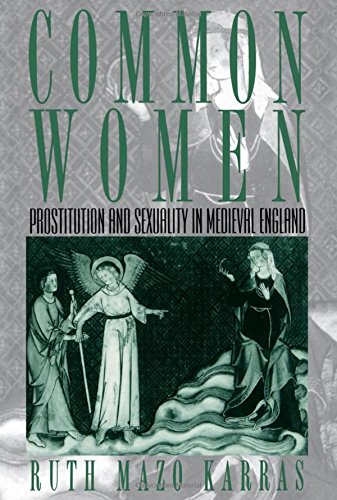
Common Women: Prostitution and Sexuality in Medieval England (Studies in the History of Sexuality), by Ruth Mazo Karras

Download PDF Common Women: Prostitution and Sexuality in Medieval England (Studies in the History of Sexuality), by Ruth Mazo Karras
Why must choose the hassle one if there is easy? Get the profit by acquiring the book Common Women: Prostitution And Sexuality In Medieval England (Studies In The History Of Sexuality), By Ruth Mazo Karras right here. You will certainly obtain different means making an offer and also obtain the book Common Women: Prostitution And Sexuality In Medieval England (Studies In The History Of Sexuality), By Ruth Mazo Karras As known, nowadays. Soft documents of guides Common Women: Prostitution And Sexuality In Medieval England (Studies In The History Of Sexuality), By Ruth Mazo Karras come to be incredibly popular amongst the visitors. Are you among them? And also right here, we are supplying you the brand-new compilation of ours, the Common Women: Prostitution And Sexuality In Medieval England (Studies In The History Of Sexuality), By Ruth Mazo Karras.
Checking out, again, will certainly give you something new. Something that you have no idea after that disclosed to be populared with guide Common Women: Prostitution And Sexuality In Medieval England (Studies In The History Of Sexuality), By Ruth Mazo Karras notification. Some knowledge or lesson that re obtained from reading publications is vast. A lot more books Common Women: Prostitution And Sexuality In Medieval England (Studies In The History Of Sexuality), By Ruth Mazo Karras you review, even more expertise you get, and also a lot more chances to always like checking out publications. Since of this factor, checking out publication needs to be started from earlier. It is as exactly what you could obtain from the book Common Women: Prostitution And Sexuality In Medieval England (Studies In The History Of Sexuality), By Ruth Mazo Karras
Get the advantages of checking out habit for your lifestyle. Reserve Common Women: Prostitution And Sexuality In Medieval England (Studies In The History Of Sexuality), By Ruth Mazo Karras message will constantly associate with the life. The reality, understanding, scientific research, health, religious beliefs, entertainment, and a lot more could be located in written publications. Numerous writers supply their encounter, scientific research, research study, as well as all things to show you. Among them is through this Common Women: Prostitution And Sexuality In Medieval England (Studies In The History Of Sexuality), By Ruth Mazo Karras This publication Common Women: Prostitution And Sexuality In Medieval England (Studies In The History Of Sexuality), By Ruth Mazo Karras will certainly supply the needed of notification as well as declaration of the life. Life will be completed if you know a lot more points with reading e-books.
From the description over, it is clear that you should read this book Common Women: Prostitution And Sexuality In Medieval England (Studies In The History Of Sexuality), By Ruth Mazo Karras We supply the online e-book entitled Common Women: Prostitution And Sexuality In Medieval England (Studies In The History Of Sexuality), By Ruth Mazo Karras right here by clicking the link download. From shared book by on-line, you can give more advantages for many individuals. Besides, the visitors will be also effortlessly to obtain the favourite e-book Common Women: Prostitution And Sexuality In Medieval England (Studies In The History Of Sexuality), By Ruth Mazo Karras to check out. Discover the most preferred and required publication Common Women: Prostitution And Sexuality In Medieval England (Studies In The History Of Sexuality), By Ruth Mazo Karras to review now and below.
Through a sensitive use of a wide variety of imaginative and didactic texts, Ruth Karras shows that while prostitutes as individuals were marginalized within medieval culture, prostitution as an institution was central to the medieval understanding of what it meant to be a woman. This important work will be of interest to scholars and students of history, women's studies, and the history of sexuality.
- Sales Rank: #673914 in Books
- Brand: Ruth Mazo Karras
- Published on: 1998-04-23
- Original language: English
- Number of items: 1
- Dimensions: 6.10" h x .70" w x 9.20" l, .75 pounds
- Binding: Paperback
- 232 pages
- Common Women Prostitution and Sexuality in Medieval England Studies in the History of Sexuality
Review
"In order to deal with both 'reality' and representation, Karras had to discover and exploit a wide variety of sources. She has skillfully woven together the records of town, manorial, and diocesan courts with insights gained from literary sources such as saints' lives, sermons, plays, and fabliaux....From the book's title to its conclusion, Karras emphasizes that control of women's independence, much more than sexuality, was at stake in the unending insistence on the shameful nature and image of women who were not 'safely under the dominion of any one man--husband, father, master.' Karras is not the first to make this point, but she argues it with authority and with a wealth of illuminating detail....This book makes a significant contribution to our appreciation of the social and cultural history not of prostitutes alone, but of all women in medieval England."--Clarissa Atkinson, American Historical Review
"Karras has put together the definitive study of prostitution in late medieval England....Avoiding the problems inherent in many other studies, Karras treads a careful and well-articulated path between seeing prostitutes only as victims or describing them as agents in control of their own destiny....Karras has written an original, stimulating, and important book that will become a standard text on the history of prostitution."--Renaissance Quarterly
"Ruth Karras's new book will become a standard text on medieval prostitution, but it will also be required reading for anyone interested in gender, sexuality, and women in the middle ages. Drawing on literary texts, religious materials, legal documentation, and other sources, Karras places prostitutes--so often seen as marginal and atypical women--at the center of gender relations in medieval England. Her sophisticated and compelling argument is a major contribution to women's history, gender history, and medieval history."--Judith Bennett, University of North Carolina, Chapel Hill
"A study of prostitution should reveal the convergence of many social forces: fear of female sexuality and venality, the fine line between approved and condemned behavior, the regulation of commercial activity, the double standard, and the distinction between the moral economy of the neighborhood and that of the fathers of society. Ruth Karras touches all these points and also turns to the voice of creative and sermon literature, as well as case studies, to put flesh on the tale."--Joel Rosenthal, State University of New York, Stony Brook
"Ruth Karras here again displays her extraordinary ability to unpack the medieval meanings of twentieth-century terms that do not adequately describe medieval phenomena. Her study replaces the modern concept of prostitution with the more accurate and very wide-ranging term "whoredom", bringing to bear and synthesizing a vast array of sources, from the legal and archival to the literary, artistic, and theological."--Edward Peters, University of Pennsylvania
From the Back Cover
"Common women" in medieval England were prostitutes, whose distinguishing feature was not that they took money for sex but that they belonged to all men in common. Common Women: Prostitution and Sexuality in Medieval England tells the stories of these women's lives: their entrance into the trade because of poor job and marriage prospects or because of seduction or rape; their experiences as street-walkers, brothel workers or the medieval equivalent of call girls; their customers, from poor apprentices to priests to wealthy foreign merchants; and their relations with those among whom they lived. Through a sensitive use of a wide variety of imaginative and didactic texts, Ruth Karras shows that while prostitutes as individuals were marginalized within medieval culture, prostitution as an institution was central to the medieval understanding of what it meant to be a woman. This important work will be of interest to scholars and students of history, women's studies, and the history of sexuality.
About the Author
Ruth Mazo Karras is at Temple University.
Most helpful customer reviews
2 of 2 people found the following review helpful.
Common Women, Uncommon Lives
By Shawn M. Warswick
Ruth Mazo Karras is currently a professor at the University of Minnesota, having earned her Ph.D. and M.Phil. in history from Yale University, and has published eight books as well as numerous articles in professional journals. Common Women, published in 1996 by Oxford University Press, is a well reasserted and well received book which looks at not only the experiences of prostitutes in the Middle Ages, it also examines the meaning of prostitution in the culture of the middle ages.
Karras argues “that prostitution deeply affected gender relations because its existence fostered the connection of feminine sexuality with venality and sin” which then justified the controlling of all women based on their sexuality. Karras conclusions are interesting as she asserts prostitution was a central pillar of medieval culture as it offered a necessary outlet for the sexual desires of men, which many people thought would undermine the social order if they were not relieved. She goes on to assert that the importance of the sex trade to our understanding of the medieval world is that understanding this phenomenon gives insight into how women responded to economic conditions by making choices for themselves whilst living in a system which afforded little opportunity to do so. Lastly, Karras says that, in a world which accepted the sex drive as natural, and yet, at the same time, set limits upon the fulfilling of that natural desire, prostitution was necessary development allowing society to function because it was central to the construction of gender in the culture of the time period.
Chapter one, “Prostitution and the Law” examines the legal understanding of what prostitution was and how it was regulated(as well as what law makers believed they were regulating). As the author notes, they understood prostitution as a commercial enterprise specifically but viewed these women as sexually immoral generally. Chapter two, “Brothels, Licit and Illicit,” discusses the brothel as an institution, one which sought to keep women sexually available for men while, at the same time, keeping these women under strict control. The next two chapters discuss the experiences of women who engaged in sex for money. Chapter three, “Becoming a Prostitution” deals with the things which influenced a woman to make the decision to become a prostitute. Karras notes that the economic structure did not favor women, and these were economic decisions. Chapter four, “The Sex Trade in Practice” is where Karras looks at the various ways in which prostitution is practiced and what types of clients came to them.
The last two chapters place prostitution into its social and cultural context. Chapter five, “Marriage, Sexuality, and Marginality” shows there is a difference between prostitutes and say a baker, in that the former comes with moral and ideological baggage attached to it in a way that no other “profession” does. Chapter six, “Saints and Sinners,” Karras says “the late medieval church’s teaching about prostitution and about whoredom must be seen against the background of a general hostility to sexuality and a widespread misogyny.” Having said that, she goes on to note the church’s view of women was not universally negative and that women did not internalize that view. Further, she notes that Medieval culture itself was not monolithically negative towards women as there were queens, holy women and other women who were both respected and revered. This is a somewhat more nuanced view offered than say Johnson, who sometimes comes across as seeing universal negativity whilst Karras sees various shades of grey so to speak.
As did the other historians discussed so far, Karras came out of the Vietnam-post Vietnam era, although she did so more to the tail end of the time period, having been a graduate student at the time of the “Reagan Revolution” of 1980 and the turn in American politics towards more conservative policies. Nonetheless, her work is still influenced by many of the trends started in the 1960’s including a desire to look at those people in history who were often ignored and a desire to insert women and their perspectives into the narrative. Thus her work is representative of subaltern studies while not being as theoretical as some of those works can be. Common Women also finds Karras using a gendered perspective and falls within the realm of women’s history. It also fits in well within the definition of social and cultural history. Finally, Karras uses some legal history, especially in the first chapter of the narrative.
This work is not only well researched but written in a very engaging and readable style, something which can be rare in the historical profession, especially when dealing with any sort of legal history. Karras does a remarkable job of not only crafting a narrative, but of questioning and commentating on the adequacy of the sources. The author also makes it clear that what is truly at stake is not the control of women’s sexuality, which is certainly important, but their overall independence. This work adds to our understanding of medieval social and cultural history overall, not just about prostitution, and is a significant contribution to the historiography of women’s medieval history.
0 of 0 people found the following review helpful.
Four Stars
By Dncng_Rue
It was exactly what I was expecting.
15 of 15 people found the following review helpful.
Well Researched
By Jeffrey Leach
This is the last book I've had to read for my Medieval history class, which focused on women in the Middle Ages. We started out by examining mystics such as Hildegard of Bingen, Julian of Norwich, and Margery Kempe, and then looked at Eleanor of Aquitaine and Joan of Arc. I guess it is fitting to end on the lowest of the female population in this time period, the prostitute. This book, by Ruth Karras, provides an in-depth analysis of the role that the prostitute played in the male dominated world of the Middle Ages, but with a twist, as Karras uses her analysis to also examine sexuality in the same period. The focus is on English prostitutes, mostly due to accessibility of records. England had a fairly stable government, so records were better preserved. France, for example, lost many court rolls and other important records in the chaos of the Revolution in the 1790's.
Karras gives a broad sketch of the prostitute by showing how they were affected by laws. The laws served a dual purpose. They seemed to try and protect prostitutes from beatings and coercion, but also tried to keep them in a restricted place in society, by isolating them to the outskirts of town, and regulating both what they could wear and how they conducted themselves in their personal relationships. The power structure, according to Karras, seemed to subscribe to the theory that prostitution was a necessary evil, in that men needed an outlet for their sexual energy. If this need wasn't met, the general belief was that these men would resort to rape and other unpleasantness against the other ladies of the town/city. So while prostitutes were reviled, they were also accorded a role in society that was seen to fill an important need.
There's lots of stuff I'm leaving out, of course. Some books always give a revelation of sorts that the reader remembers long after the book has been read, and this one has a good one. England had very few legal brothels, but one was on the outskirts of London, in Southwark. These brothels were referred to as "stews", and this stew was actually owned by the Bishop of Winchester! He made quite a profit off the ladies, too. He didn't run the house directly, but appointed brothelkeepers who did the dirty work. An interesting role for the Church, don't you think? Actually, it sort of makes since in light of the belief that prostitution filled a social role of sorts. The government sure wasn't providing any sort of programs or assistance. The Church was the closest thing to a social service system (I'm way out on a limb here, I smell a research paper!) so maybe bishops running houses of ill repute wasn't so spectacular after all.
Copious notes at the end of the book show the astonishing amount of primary and secondary sources that Karras scoured through to construct the book. I'm impressed. This book certainly has an interest to the historian, but the casual reader would get a kick out of it too, as it isn't overly scholarly, and it reads fast at 142 pages. Well done, Dr. Karras!
Common Women: Prostitution and Sexuality in Medieval England (Studies in the History of Sexuality), by Ruth Mazo Karras PDF
Common Women: Prostitution and Sexuality in Medieval England (Studies in the History of Sexuality), by Ruth Mazo Karras EPub
Common Women: Prostitution and Sexuality in Medieval England (Studies in the History of Sexuality), by Ruth Mazo Karras Doc
Common Women: Prostitution and Sexuality in Medieval England (Studies in the History of Sexuality), by Ruth Mazo Karras iBooks
Common Women: Prostitution and Sexuality in Medieval England (Studies in the History of Sexuality), by Ruth Mazo Karras rtf
Common Women: Prostitution and Sexuality in Medieval England (Studies in the History of Sexuality), by Ruth Mazo Karras Mobipocket
Common Women: Prostitution and Sexuality in Medieval England (Studies in the History of Sexuality), by Ruth Mazo Karras Kindle

Tidak ada komentar:
Posting Komentar